

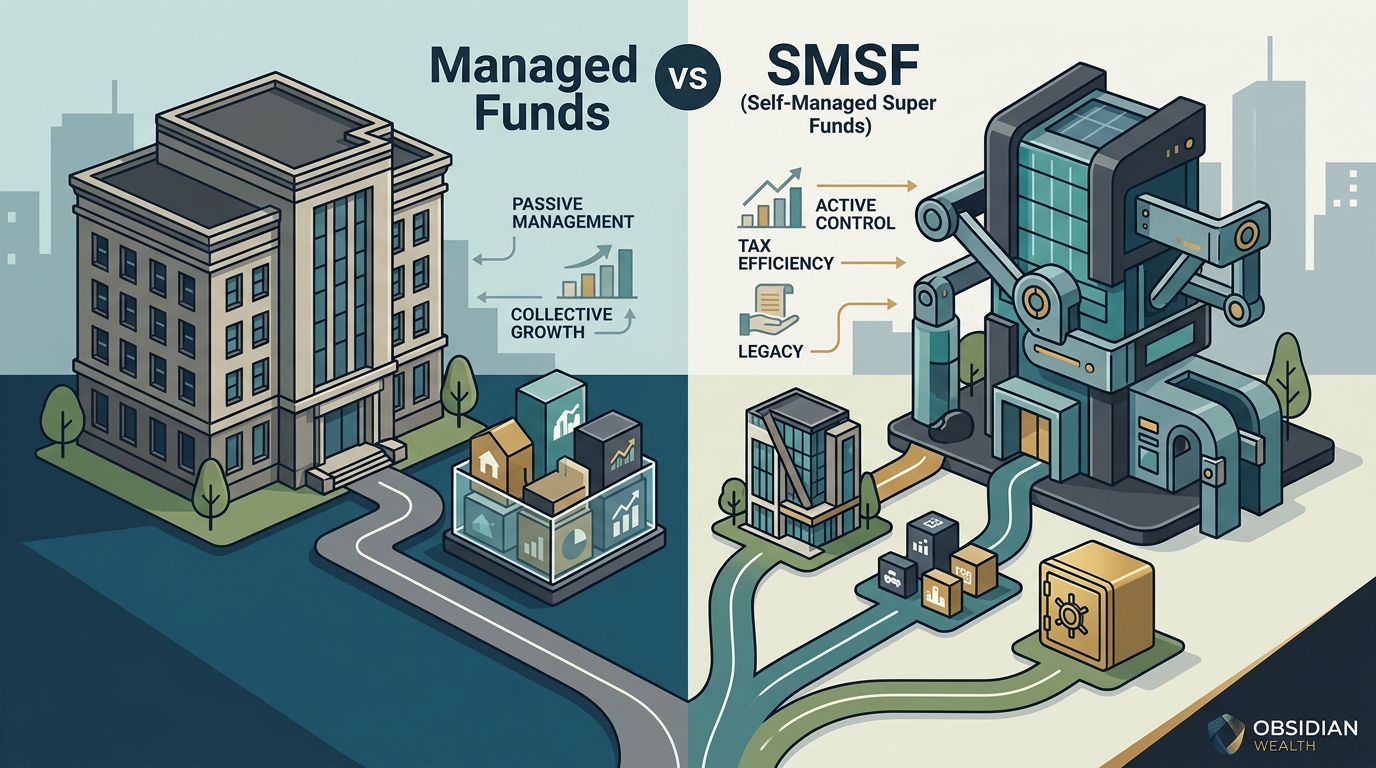
For ambitious professionals and business owners in Melbourne, the question of how to structure investment growth is rarely just about returns. It is about control, tax efficiency, and legacy. According to the Australian Prudential Regulation Authority, there are over 650,000 Self-Managed Super Funds (SMSFs) in Australia, representing a significant shift toward direct ownership of assets. This data shows that high-net-worth individuals are increasingly moving away from passive management to active control. However, this shift requires rigorous discipline and a clear understanding of the trade-offs involved. (Wealth Management Services Melbourne)
Choosing between a Self-Managed Super Fund and a Managed Fund is not merely a financial decision; it is an identity decision. It defines how much time you dedicate to administration versus strategy. At Obsidian Wealth, we help clients evaluate these structures to ensure their wealth creation strategies align with their long-term financial freedom goals. (Financial Adviser Melbourne Obsidian)
What is an SMSF?
An SMSF is a private superannuation fund that you and your co-trustees manage directly. Unlike industry funds, where a board makes decisions for thousands of members, an SMSF gives you complete authority over every investment choice. This structure allows for direct ownership of assets such as residential property, listed shares, and even business real estate. (Private Wealth Management Melbourne)
The primary appeal of an SMSF is the ability to tailor your portfolio to your specific risk profile and ethical values. You are not limited to the standard asset classes offered by large financial institutions. However, this freedom comes with significant administrative responsibilities. You must ensure strict compliance with the Superannuation Industry (Supervision) Act 1993. Failure to comply can result in severe penalties and the loss of tax concessions. (Financial Planning Insights Melbourne)
For business owners and high-income earners, the SMSF offers a unique platform for wealth creation. It allows for the consolidation of super balances, potentially lowering management fees as the fund grows. It also provides a vehicle for estate planning, ensuring that your superannuation benefits are distributed according to your wishes rather than default legal frameworks.
What is a Managed Fund?
A managed fund pools money from many investors to purchase a diversified portfolio of assets. Professional fund managers make the day-to-day investment decisions based on the fund's stated objective, such as growth, income, or balanced strategies. This approach is often described as "set and forget," appealing to those who prefer not to be involved in the operational details of their investments.
Managed funds offer immediate diversification. By holding a small portion of a managed fund, an investor gains exposure to hundreds or thousands of securities. This reduces the risk associated with individual stock or property performance. For individuals with smaller superannuation balances, managed funds are often more cost-effective because the economies of scale allow for lower fees relative to the assets under management.
The downside is the lack of control. You cannot choose which specific companies the fund invests in, nor can you adjust the strategy quickly in response to market changes. You are reliant on the fund manager's expertise and integrity. While professional management can outperform amateur investors in volatile markets, it also means you are paying for that expertise, which can erode net returns over time.
Cost Comparison: Fees and Expenses
Understanding the cost structure is critical when comparing these two vehicles. SMSFs have fixed costs that do not scale down with smaller balances. These include audit fees, accounting fees, legal costs, and insurance premiums. For a fund with less than $500,000, these fixed costs can represent a significant percentage of the total balance, potentially outweighing the benefits of direct investment.
Managed funds typically charge ongoing management fees, often expressed as a percentage of assets under management (AUM). These fees might range from 0.5% to 2% annually, depending on the complexity of the strategy. While this percentage seems small, it compounds over decades. However, for larger balances, the percentage fee may become more competitive than the fixed costs of an SMSF.
| Feature | Self-Managed Super Fund (SMSF) | Managed Fund |
|---|---|---|
| Control | Full control over investment choices | Professional manager makes decisions |
| Cost Structure | Fixed annual costs (audit, admin) | Percentage of assets under management |
| Minimum Balance | Typically $200k-$500k+ for viability | Often $0 to start |
| Investment Options | Unlimited (property, direct shares) | Limited to fund's mandate |
| Compliance Burden | High (legal and reporting duties) | Low (handled by provider) |
Control and Investment Flexibility
The most significant differentiator between an SMSF and a managed fund is control. With an SMSF, you can invest in assets that are unavailable in standard superannuation products. This includes direct ownership of commercial or residential property, private equity, and collectibles. This flexibility allows for a more customized approach to wealth creation and growth.
For example, if you own a business, you may be able to lease business real estate to your company from your SMSF. This creates a tax-effective way to hold property while building superannuation assets. Such strategies are complex and require careful structuring to ensure they comply with arm's length rules.
In contrast, managed funds offer limited flexibility. You choose the fund, but you cannot dictate its holdings. If the market shifts, you must wait for the fund manager to rebalance or choose to switch funds entirely. This lack of agility can be a disadvantage in rapidly changing economic environments where quick decisions are necessary to protect capital.
Tax Efficiency and Estate Planning
Tax efficiency is a major driver for SMSF adoption. In the accumulation phase, earnings within an SMSF are taxed at a concessional rate of 15%. In the pension phase, earnings are tax-free. This is generally lower than the marginal tax rates paid by high-income earners. Additionally, SMSFs offer greater flexibility in tax planning strategies, such as capital gains tax discounts and franking credits.
Estate planning is another area where SMSFs excel. You can nominate beneficiaries who will receive your superannuation benefits upon your death. This ensures that your wealth is distributed according to your specific wishes, rather than being subject to the default rules of the fund or the law. This is particularly important for blended families or those with complex family dynamics.
Managed funds also offer tax benefits, but they are less flexible. The fund manager handles the tax implications, and you receive a tax statement at the end of the year. While this simplifies your personal tax return, it limits your ability to optimize the tax outcome for your specific financial situation.
Risk Management and Compliance
With great control comes great responsibility. SMSF trustees are legally responsible for ensuring the fund is managed in the best interests of its members. This includes maintaining accurate records, conducting regular audits, and adhering to strict investment rules. The risk of non-compliance is real and can result in heavy penalties.
Professional advice is essential for SMSF trustees. At Obsidian Wealth, we provide ongoing advice to help clients navigate the complex regulatory landscape. We help structure the fund, review investment strategies, and ensure that the SMSF remains aligned with the client's overall financial plan.
Managed funds mitigate this risk by outsourcing compliance to the provider. The fund manager is responsible for regulatory adherence, and investors are protected by the Australian Securities and Investments Commission (ASIC). This makes managed funds a safer option for those who lack the time or expertise to manage an SMSF effectively.
Key Takeaways
- Balance Threshold: SMSFs are typically most cost-effective for balances exceeding $500,000 due to fixed administrative costs.
- Investment Scope: SMSFs allow direct investment in property and private assets, while managed funds are limited to their specific mandate.
- Tax Strategy: SMSFs offer superior tax planning flexibility, including capital gains discounts and franking credit optimization.
- Compliance Burden: SMSF trustees bear full legal responsibility for compliance, requiring professional audit and accounting support.
- Control vs. Convenience: Managed funds offer convenience and diversification, while SMSFs offer control and customization.
- Estate Planning: SMSFs allow for binding death benefit nominations, ensuring wealth is distributed according to your wishes.
- Professional Guidance: Successful SMSF management requires ongoing strategic advice to navigate regulatory changes and market conditions.
Frequently Asked Questions
Is an SMSF always better than a managed fund?
No. For smaller superannuation balances, the fixed costs of an SMSF can outweigh the benefits. Managed funds are often more cost-effective and efficient for balances under $200,000.
Can I invest in property with a managed fund?
Generally, no. Managed funds invest in a diversified portfolio of assets as determined by the fund manager. Direct property ownership is typically a feature of SMSFs.
How much does it cost to run an SMSF?
Costs vary based on complexity but typically include audit fees, accounting fees, and insurance. These are fixed costs, so they represent a higher percentage of smaller balances.
Do I need a financial adviser for an SMSF?
While not legally required, it is highly recommended. An adviser can help ensure your investment strategy aligns with your overall financial goals and compliance requirements.
What happens to my SMSF if I die?
Your SMSF can pay benefits to your nominated beneficiaries. This allows for greater control over estate distribution compared to many managed funds.
Can I switch from a managed fund to an SMSF?
Yes, you can roll over your managed fund balance into an SMSF. However, you should consider the costs and administrative burden before making this switch.
Are SMSFs risky?
SMSFs carry concentration risk because you choose the investments. Diversification is your responsibility. Managed funds offer built-in diversification, which can reduce individual asset risk.
Book Your Clarity Call
Deciding between an SMSF and a managed fund is a pivotal moment in your financial journey. It requires a clear understanding of your goals, risk tolerance, and administrative capacity. At Obsidian Wealth, we specialize in helping Melbourne professionals and business owners design integrated wealth strategies that bring every part of your financial life into one plan.
Whether you are looking to optimize your superannuation, manage debt, or plan for retirement, we provide the guidance you need to make informed decisions. Book a 15-minute Clarity Call with our team to discuss your unique financial situation and explore how an SMSF or managed fund might fit into your long-term wealth creation strategy.